Before the engine ignites and the wheels begin to roll, there is silence.
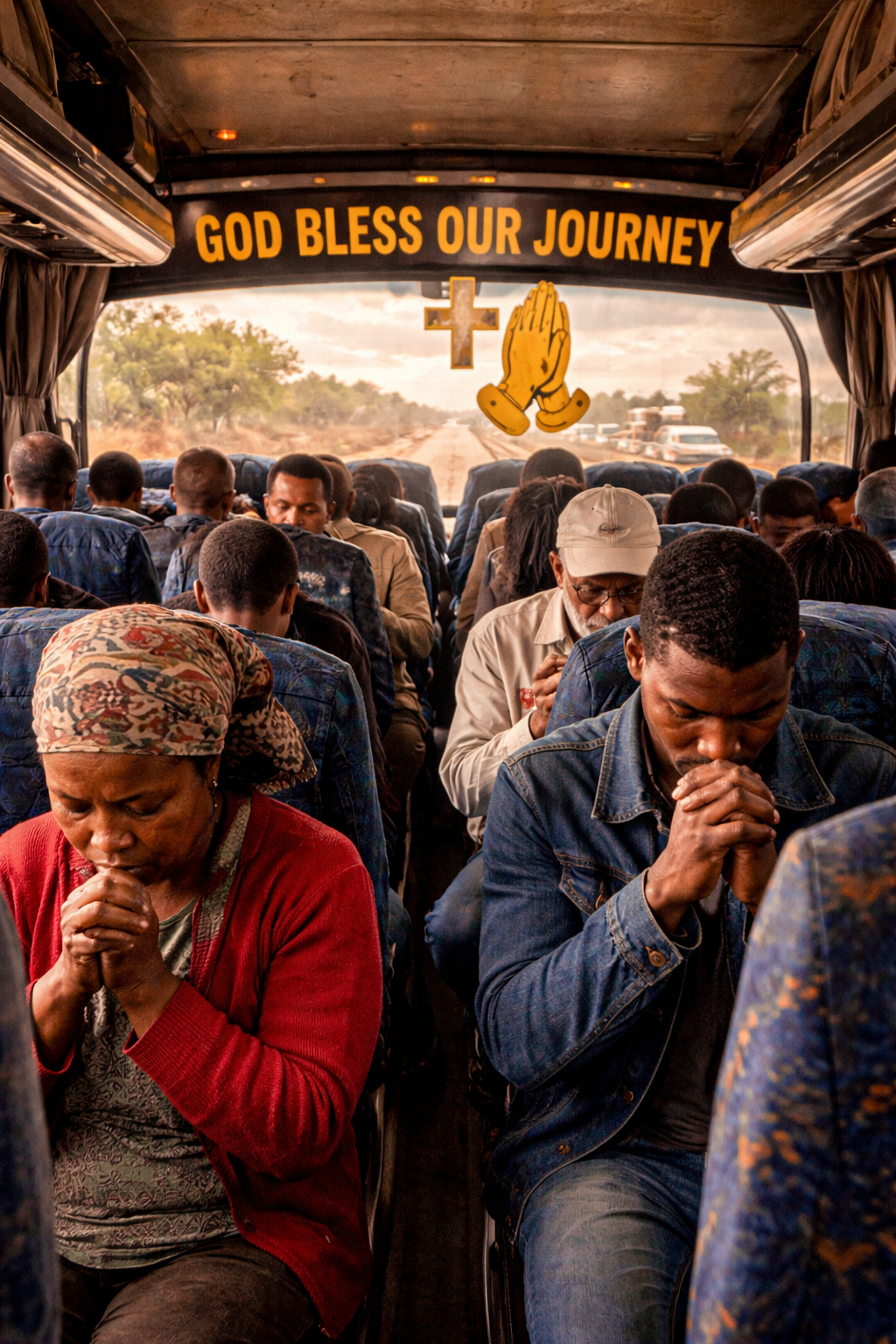
Not the ordinary silence of passengers glued to their phones or staring out of dusty windows—but a sacred pause.
On Zimbabwe’s highways, prayer has become as essential as fuel.
Across the country, from Harare to Bulawayo, Mutare to Victoria Falls, a quiet but powerful ritual is unfolding aboard public transport buses. Before every journey begins, bus crews are asking passengers to pray.
And remarkably, everyone prays.
A Nation on Its Knees—On the Move
Zimbabwe’s highways have increasingly become corridors of tragedy. Mangled wreckage by the roadside, fresh skid marks on tar, headlines announcing yet another fatal crash—these are scenes that have become painfully familiar.
Passengers know this.
Drivers know this.
Bus crews know this.
So before departure, a conductor or driver often stands up and says words that have now become common: “Before we travel, let us pray for journey mercies.”
Heads bow. Hands fold. Some whisper. Others pray aloud.
For a few minutes, strangers become one congregation.
Faith as the Ultimate Seatbelt
Inside these buses are people from every walk of life—vendors heading to markets, students returning to school, families visiting relatives, workers chasing opportunity. They carry different stories, different struggles, and different fears.
But they share one belief: that protection on Zimbabwe’s roads goes beyond speed limits and traffic laws.
Many passengers openly declare that it is God who protects them.
“Our roads have become death traps,” said one regular commuter. “You can’t rely only on the driver’s skill. You need God.”
In a country where infrastructure challenges, reckless driving, and mechanical failures contribute to accidents, prayer has become an invisible shield—what some call the “ultimate insurance policy.”
When Strangers Become a Prayer Circle
What is striking is not just that crews initiate prayer—but that passengers willingly participate.
There is no hesitation.
Christians pray in the name of Jesus. Others pray silently. Some close their eyes tightly as if holding onto hope itself. Even those who rarely attend church often join in.
For a moment, economic differences disappear. Political differences dissolve. Social divisions fade.
On the bus, everyone is simply a traveler asking for safe arrival.
Fear, Faith, and the Reality of the Road
Road safety experts point to human error, poor road maintenance, and vehicle conditions as major causes of accidents. Statistics show that hundreds of lives are lost annually in traffic collisions across Zimbabwe.
Yet beyond policy debates and enforcement campaigns, faith has quietly become part of the road culture.
Drivers themselves often lead the prayers, acknowledging that once on the highway, many factors are beyond human control—weather, other drivers, stray animals, brake failure.
“Prayer gives us peace,” said one bus crew member. “After we pray, we feel covered.”
A Spiritual Response to a National Crisis
In many ways, these bus prayers reflect something deeper about Zimbabwean society: resilience through faith.
When systems feel fragile and risks feel high, people turn to what they trust most—their belief in divine protection.
Some passengers even speak of spiritual dangers, believing that unseen forces can follow individuals or influence misfortune. Whether symbolic or literal, such beliefs highlight how deeply spiritual interpretation shapes the travel experience.
In the face of uncertainty, prayer becomes protection, reassurance, and unity.
The Journey Continues
After the final “Amen,” the engine roars to life.
Conversations resume. Music plays softly from a speaker. The bus merges onto the highway.
But something has shifted.
The journey no longer feels ordinary—it feels entrusted.
On Zimbabwe’s highways, before rubber meets the road, faith moves first.
And for many travelers, that makes all the difference.