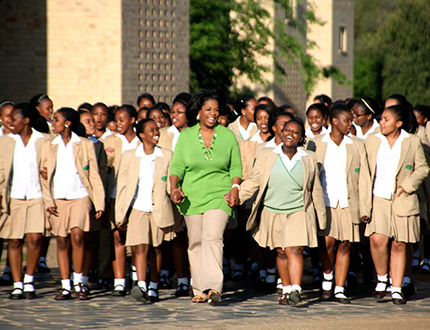
For almost two decades, the Oprah Winfrey Leadership Academy for Girls sat on 52 acres in Henley on Klip, South Africa. Behind its gates, a bold idea lived out loud: that investing in girls from disadvantaged backgrounds could change a nation.
This week, Oprah Winfrey announced that idea is about to grow bigger, even as the campus that housed it prepares to close as a residential school.
“For nearly 20 years, the Oprah Winfrey Leadership Academy for Girls has been one of the deepest expressions of my life’s purpose,” she wrote in a personal reflection. “Thousands of days. Hundreds of young women. Countless moments that changed not only their lives, but mine.”
After “years of reflection, conversations, planning, and prayer,” she said the time had come for the Academy to “evolve from a single residential campus into a scholarship program that could reach even more girls across South Africa.”
When the Academy opened in 2007, it was unlike anything on the continent. Girls were selected not just for academic excellence, but for leadership potential and resilience. They received full scholarships, housing, healthcare, and mentorship.
The goal was clear create a pipeline of African women leaders.
And it worked. Graduates have gone on to Ivy League universities, medical schools, and leadership roles in government and business. But Oprah’s tribute this week focused less on outcomes and more on the people behind them.
“One by one, I met with the people who have poured their hearts into this place,” she wrote. “Teachers who have devoted decades to nurturing these extraordinary girls. Administrators who quietly solved a thousand problems no one ever saw. Gardeners who made sure that beauty greets every person who walks the pathways of this incredible campus.
That emphasis on care on dignity in small details is what made the Academy different. It wasn’t just classrooms.
The decision to move away from a single campus is painful, Oprah admitted. “I knew it was the right decision, but that didn’t make it hurt any less.”
The reason is scale. A residential school, no matter how well, resourced, can only serve a few hundred students at a time. South Africa has millions of girls who need support.
By shifting to a scholarship model, the program can partner with existing schools across all nine provinces. More girls can access funding, mentorship, and leadership training without having to leave their communities.
It mirrors a broader shift in global philanthropy from building institutions to building networks. It’s less visible, but potentially far more powerful.
Details of the new scholarship program are still being rolled out. The focus will be on identifying high potential girls and supporting them through secondary school and university, with the same leadership curriculum that defined the Academy.
For South Africa, the move comes at a critical time. Education inequality remains one of the country’s biggest challenges. A model that spreads resources instead of concentrating them could help bridge that gap.
For the region, including Zimbabwe, it’s a case study. How do you take a successful pilot and turn it into something national? How do you keep the intimacy of mentorship when you’re no longer under one roof?
The red brick buildings in Henley on Klip will always matter. They were the proof of concept. But Oprah’s message is clear the purpose was never the campus. The purpose was the girls.
“Countless moments that changed not only their lives, but mine,” she wrote. Now those moments will happen in classrooms in Durban, Soweto, Limpopo, and beyond.
The gates may close. But the mission is walking out of them one scholarship, one girl, one community at a time.
And that, she believes, is how a dream truly scales.