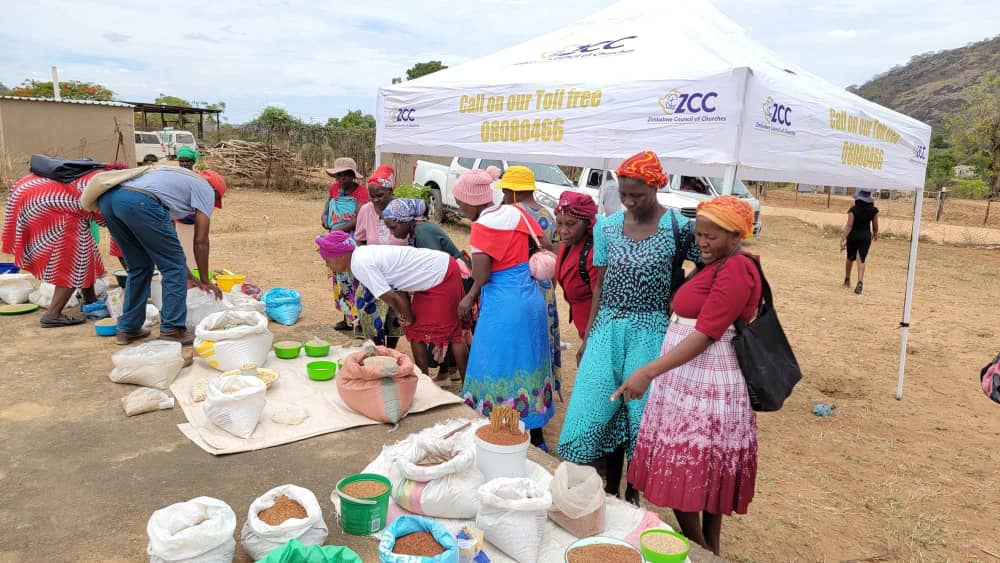
As the 2025/2026 farming season set to begin, more than 150 farmers from different rural communities recently benefited from the Seed Fairs which were organized by the Zimbabwe Council of Churches (ZCC) with the aim of creating a platform for farmers to showcase their seeds, to buy and sell among themselves strengthening economic empowerment, local seed systems, ensuring timely seed access before planting season, promoting equitable access to seeds and community resilience.
Speaking during the Seed Fair, one of the farmers Tovai Nemaparwe from Gutu Ward 15 commended the Fair saying that it has brought a relief to them as farmers by eliminating transport costs that they have been facing whenever they wanted to buy seeds in nearby towns.
“This Seed Fair has been a blessing for us. I normally travel all the way to Gutu growth point or even Harare to buy inputs and spend up to US$30 just on transport.
“Today, I bought my seeds right here at home and used the money that I had saved to buy even more inputs. This Seed Fair has truly helped us as farmers,” said Nemaparwe
Speaking about the Seed Fairs, ZCC said that promoting heritage-based seed systems has been key to building climate-smart food systems.
“In an era where climate change is causing recurrent droughts, unpredictable rainfall patterns, and crop failures, promoting heritage-based seed systems is key to building climate-smart and shock-responsive food systems.
“The fairs have been attended by over 150 farmers, brought seed suppliers closer to rural farmers, reducing transport costs and increasing access to vital inputs needed for the 2025/2026 farming season. We extend our appreciation to government stakeholders and our partners The United Church of Canada and Canadian Foodgrains Bank for their support in empowering farming communities,” said ZCC.
The Zimbabwe Council of Churches (ZCC) Seed Fairs which were under the Scaling Up Resilience Program (SURP) have been running under the theme: “Heritage-Based Seed Systems: A Solution to Sustainable Food Systems.”
The theme highlights the power of indigenous and traditional seed varieties as a pathway to food sovereignty, household nutrition, and climate resilience.